

The decision to wind down vehicle production is undeniably emotional, especially for a site that has become part of Dresden’s identity. Yet the vision replacing it carries a kind of momentum that makes the transition feel almost inevitable. Beginning next year, Volkswagen, the State of Saxony, and the Technical University of Dresden will be joining forces to transform the Manufaktur into a research hub dedicated to artificial intelligence, robotics, microelectronics, chip design, sustainable mobility, and circular systems. It is a strategic partnership that has been backed by more than 50 million euros over the past seven years, complete with four new endowed professorships and a shared commitment to close the gap between academic discovery and industrial application. The plan is clear: build a place where future-defining technologies can be developed openly, collaboratively, and visibly.
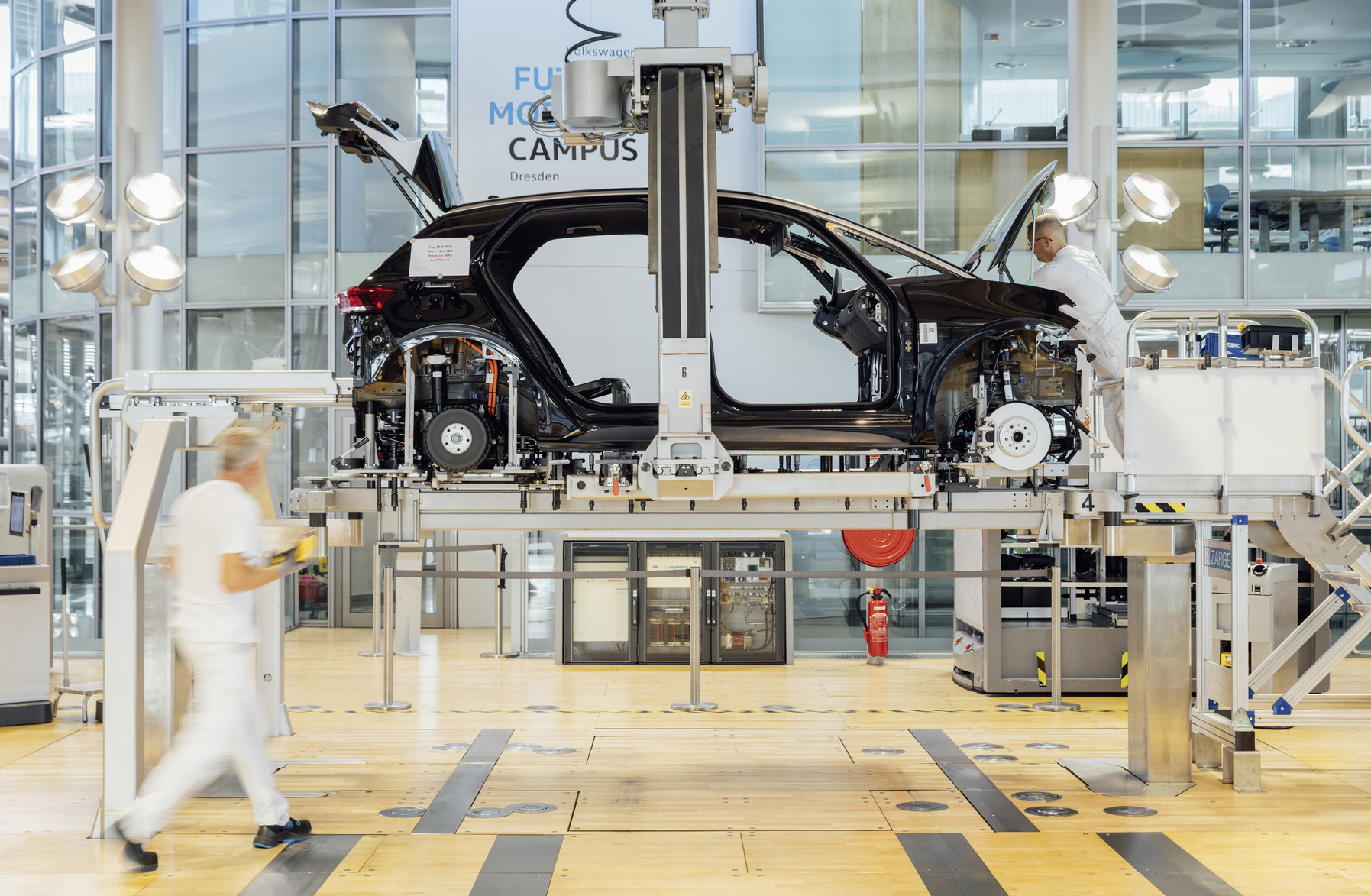
What makes this shift remarkable is that the Manufaktur is not being retired, it’s being expanded. It will remain Volkswagen’s second-largest vehicle handover location in Germany, continue to welcome more than 100,000 visitors each year, and evolve into a living laboratory where the public can witness the mechanics of innovation just as transparently as they once saw the assembly of electric vehicles. Instead of a production line, guests will observe robots learning new tasks, engineers working on microchips, researchers exploring AI models, and startups taking their first steps in a real-world mobility ecosystem. It takes the original concept even further: creating transparency that extends beyond manufacturing to envisioning the future.
For Saxony, this transformation is about more than a single building. It signals a commitment to shaping the region’s future. By integrating the new TUD InnoX Campus, taking inspiration from global innovation hubs such as Station F in Paris, directly into the Manufaktur, Saxony positions itself as a key player in Europe’s mobility transition. With its strong semiconductor industry, leading research institutions, and now a prominent innovation hub built on automotive expertise, the region is making clear that it aims not just to follow technological change, but to help drive it.
Volkswagen’s approach in Dresden addresses a challenge facing the entire automotive industry: how to move from traditional car production to future-focused mobility while retaining what made the company relevant. Rather than shutting down operations, the Manufaktur is being reimagined as a space where innovation is as visible as manufacturing once was. Success in the next era of mobility will depend not on the number of cars produced, but on how effectively software, materials science, robotics, and digital ecosystems are combined. In Dresden, that convergence now has a home - with glass walls.
The timeline for this transition is already underway. As production winds down in mid-December and the ID.3 assembly line is dismantled in early 2026, work on the new research spaces will begin immediately. By mid-2026, Volkswagen and TU Dresden will start their first joint projects, with the Innovation Campus expected to be fully operational in 2027. Customers picking up their vehicles will walk through a building where researchers are already shaping the technologies behind the next generation of mobility.
The transparent factory is not becoming less transparent - it is becoming more relevant. What once showcased the craftsmanship of an electric vehicle will now reveal the thinking, experimentation, and collaboration behind tomorrow’s mobility systems. Dresden is not losing a factory; it is gaining a vision - one that demonstrates how the most meaningful innovations happen when industry, academia, and the public share the same space, both literally and figuratively. The Gläserne Manufaktur began as a symbol of openness. Today, it is a symbol of what is possible when openness meets reinvention.


Photo Copyright: Volkswagen Newsroom
Secure your MOTION MAG copy online now!

